Deep Work - Cal Newport
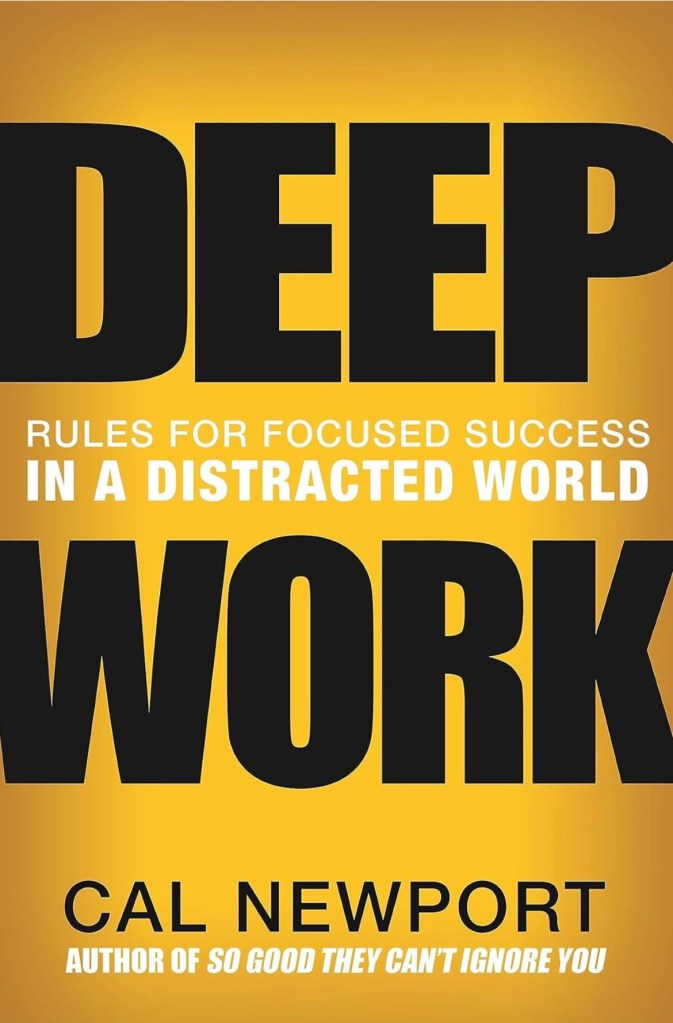
Deep Work
Notes:
- Introduction
- Deep Work: Professional activities performed in a state of distraction-free concentration that push your cognitive capabilities to their limit. These efforts create new value, improve your skill, and are hard to replicate.
- The Deep Work Hypothesis: The ability to perform deep work is becoming increasingly rare at exactly the same time it is becoming increasingly valuable in our economy. As a consequence, the few who cultivate this skill, and then make it the core of their working life, will thrive.
- Three to four hours a day, five days a week, of uninterrupted and carefully directed concentration, it turns out, can produce a lot of valuable output.
- Deep work is Valuable
- In this new economy, three groups will have a particular advantage: those who can work well and creatively with intelligent machines, those who are the best at what they do, and those with access to capital.
- Two Core Abilities for Thriving in the New Economy 1. The ability to quickly master hard things. 2. The ability to produce at an elite level, in terms of both quality and speed.
- To learn hard things quickly, you must focus intensely without distraction.
- A journalist who specializes in data analysis for the election results by inputting different data from the various sources and he mastered the specialized software which is the hard one to learn
- Person who locks himself in a private cabin and finishes his work without distractions
- Hard workers – ability to learn the harder things by working hard
- Superstars – natural talents – Adam Grant becomes the assistant professor in the Wharton School of Business in short time. He still sits in the university office but will display as OOO for the dedicated work
- Owners – who owns the servers or spend on the machines which helps to perform high performance tasks at a greater level
- Deep work is nothing but the ability to learn the hard things without distractions and produce the results at an elite level
- Deep Work is Rare
- The Principle of Least Resistance: In a business setting, without clear feedback on the impact of various behaviors to the bottom line, we will tend toward behaviors that are easiest in the moment.
- Busyness as Proxy for Productivity: In the absence of clear indicators of what it means to be productive and valuable in their jobs, many knowledge workers turn back toward an industrial indicator of productivity: doing lots of stuff in a visible manner.
- Facebook announced the concept of open model office workspaces. It’s good to reach out to the team members for the help or questions. But it’s highly distracting and employees can’t focus on the deep work
- IBM introduced the concept of instant messaging and it flashes on the screen for other employees in their terminal when someone types the message immediately
- Ex CEO of Yahoo measured the employee’s server log time for the remote login work hours and punished employee who logged less hours. She could have fired Adam Grant
- Continuous project meetings not only takes every one’s time but doesn’t help with the deep work
- Same with continuous instant messaging
- Deep work is meaningful
- Human beings, it seems, are at their best when immersed deeply in something challenging.
- To build your working life around the experience of flow produced by deep work is a proven path to deep satisfaction.
- Part 2 Rules
- Rule 1 Work Deeply
- There are 4 types of deep working style
- Monarch- completely isolate from the day to day life and focus on the work to complete- Carl Jung
- Bimodal – Isolate yourself when required and work where you are located like being in office or home
- Journalistic type – Get into deep work whenever can from the day to day work – Cal follows this approach
- Ritualize – make it the habit of when and how you will do the deep work
- IBM CEO hired the Harvard professor to discuss with him regarding how to combat the competition from the low price processors selling company like AMD. The startups normally get into the habit of low price products selling and later get into the high quality products making and acquired by the big companies later. He struggled to know how to do it than what to do it and he knows what to do it
- The professor written the book 4 execution dimensions and the modal for the business to follow but Cal uses it for deep work
- Embrace the boredom
- Jews has the habit of getting into the deep work early morning by reading the complex subjects
- When we stand in the queue waiting for us to be called, we do not like to be bored. We immediately get into the habit of checking the phone
- We can not be healthy if we eat healthy only a day per week like following deep work only a day per week
- Instead of having time block for deep work from the distractions and have the time block for distractions from the deep work
- If we time block for distractions, we tend to grave more and more
- If we time block for deep work by shutting everything, our mind still does not focus for the deep work
- Internet sabbath – digital detox
- Quit Social Media
- Malcom Caldwell, Lewis and others don’t have twitter account and they don’t know how to use the twitter account.
- 80/20 rule. Their achievements is from the 20% of deep work done. In business, 80% of the revenue is coming from 20% of the customers and business owners concentrate on the 20% of those people only
- When we silently exit Facebook for 30 days, then we can notice that if we anyone missed us really or not
- These apps are designed to attract us to spend more and more time and waste our time and does not allow us to focus on the deep work
- Example is given when a person has packed everything he had into boxes and then open the box he needs and found that most of the items are not needed
- Our mind does not need rest except sleep but needs changes and challenges
- Drain shallowness
- Time blocking each day is great principle.
- Tips to avoid the bombarding emails to our Inbox. Avoid replying to the emails if the email contents is not clear and will take our time
- Reply to the emails by taking little time and pushing the actions to the senders and and specify the exact date and times convenient to meet to discuss
- If we reply shallow, they will bombard us only and drain our time
- Cal’s professors does not reply to students emails if they write simply want to meet. Instead if they write with specific details and date and time ex. Fifteen minutes after class on Thursday and would like to contribute for a work, will get the reply from the professors
- Cal does not give his personal email id anywhere. He clearly says for the purposes his email address is shared in his site
- Rule 1 Work Deeply

 Muthu Kalimuthu
Leave a comment